The 2027 placed-in-service line
Solar that hadn't begun construction by July 4, 2026 generally must be placed in service by December 31, 2027 to earn the 48E or 45Y credit. Procurement and interconnection take months.
Manufacturers & industrial
Your roof may be the largest idle asset on the balance sheet, and your customers have started asking about it. We test whether on-site solar, a green tariff, or neither fits your load, your contracts, and the federal calendar.
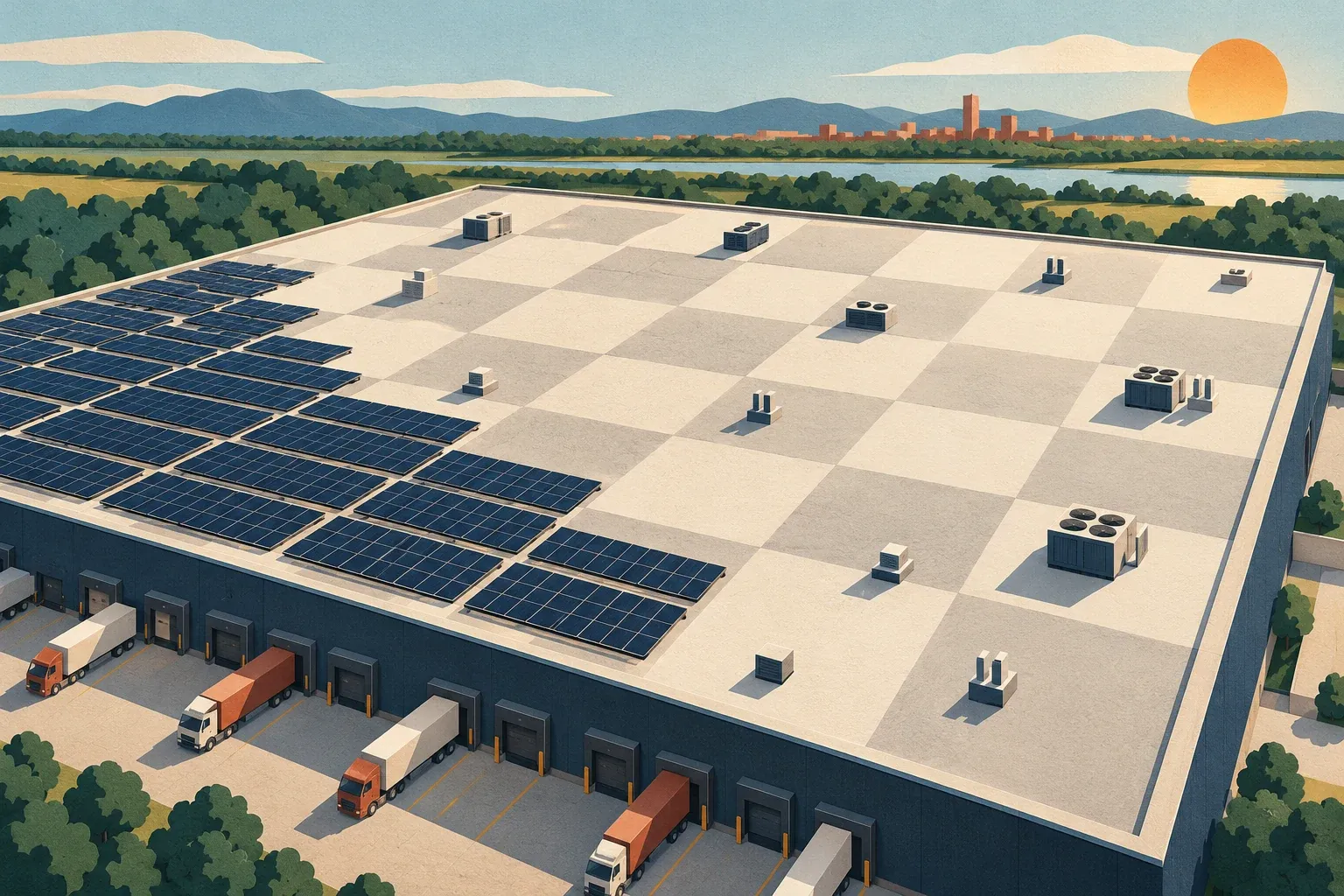
A factory roof is often the largest unused asset on the balance sheet. The opening move matters most.
For Kentucky manufacturers, industrial solar feasibility comes down to three questions. Does your load line up with the sun? Can a project be built before the federal credit window closes? And what do your customers need you to claim? A large roof makes the conversation possible. Those three answers decide whether it’s worth having.
We’re an independent, fee-only firm. We don’t sell, design, or install systems, and we take no money from developers, installers, or equipment makers. We work from your bills, interval data, and contracts, and we show every assumption.
Two plants that each use 12 million kWh a year can get very different value from the same array. A three-shift operation running weekends absorbs nearly every midday kilowatt-hour. A single-shift plant that idles on Saturdays exports more, and exported power is credited at less than retail. Twelve months of 15-minute interval data for each meter answers the question faster than any rule of thumb.
For solar that hadn’t begun construction by July 4, 2026, the 48E and 45Y credits generally require the facility to be placed in service by December 31, 2027. Projects beginning construction after 2025 also face restrictions on material assistance from prohibited foreign entities. As of November 2026, that leaves about 14 months for everything:
| Step | Typical duration |
|---|---|
| Commercial feasibility study | 3–5 weeks |
| Installer RFP and bid leveling | 4–8 weeks |
| Equipment sourcing documentation | 2–6 weeks, overlapping the RFP |
| Interconnection review, permits, and construction | Months, depending on size and circuit |
Tight, but workable for many rooftop projects that start now. Your tax adviser confirms eligibility; we build and track the schedule. Our credit deadline timeline walks through the dates.
Supplier sustainability questionnaires increasingly ask for Scope 2 emissions reported both ways, location-based and market-based, as the GHG Protocol Scope 2 Guidance describes. Here’s the catch: if a third-party owner keeps the renewable energy certificates from the array on your roof, your market-based figure can’t count that solar. The panels lower your bill. They don’t automatically lower your reported emissions.
That’s why Priya Venkataraman, our sustainability reporting lead, often starts with the questionnaire rather than the roof. Sometimes a REC purchase or a green tariff answers the customer faster and with less capital. In LG&E and KU territory, the Green Tariff offers RECs, an on-site Business Solar option, and a Renewable Power Agreement aimed at large customers.
Lenders, tax advisers, and customers now want records for major components. We run competitive RFPs, level the bids, and assemble the equipment sourcing documentation your advisers will ask for. A licensed structural engineer confirms what the roof can carry; we make sure that question gets asked in week one, not week ten.
Most plants begin with a Commercial Feasibility Study. If a customer questionnaire is due first, start with Supplier Sustainability Questionnaires.
What we hear most
Solar that hadn't begun construction by July 4, 2026 generally must be placed in service by December 31, 2027 to earn the 48E or 45Y credit. Procurement and interconnection take months.
Projects that begin construction after 2025 face limits on material assistance from prohibited foreign entities. Bids need documentation, not assurances.
A three-shift plant and a one-shift plant with the same annual usage can get very different value from the same array. Interval data settles it.
Large customers increasingly send suppliers questionnaires about Scope 2 emissions and renewable claims. Owning panels is not the same as owning the claim.
A big roof may be near the end of its membrane life or short on load capacity. A licensed structural engineer has to confirm what it can carry.
Recommended

Service
An independent study of on-site solar for businesses and public bodies, built on interval data, your actual tariff and federal credit deadline scenarios.
See the service
Service
We write an RFP from your requirements, invite installers you choose or we research, run the Q&A and level every bid into one scored comparison and shortlist.
See the service
Service
Supplier research, spec and quote comparisons, lead-time tracking and an organized file of manufacturer and country-of-origin documents for commercial solar and storage buyers.
See the service
Service
An annual, non-certified estimate of emissions from purchased electricity using the GHG Protocol Scope 2 Guidance and EPA eGRID factors, with location-based and market-based results and a methods memo.
See the service
Service
Help for Kentucky suppliers answering customer sustainability questionnaires and portal requests: a repeatable energy and emissions data file, consistent narrative answers and renewable option evaluation.
See the service
Service
Recurring, independent performance reports for owners of several solar systems: expected versus actual, performance ratio, availability and a ranked alert triage list.
See the serviceFAQ
Not necessarily, but the window is narrow. For solar that hadn't begun construction by July 4, 2026, the 48E and 45Y credits generally require the facility to be placed in service by the end of 2027, and sourcing restrictions apply. We build a schedule backward from that date; your tax adviser confirms eligibility.
We prepare non-certified Scope 2 estimates using the GHG Protocol Scope 2 Guidance and published emission factors such as EPA eGRID, and we draft responses for your review. We don't provide third-party verification or assurance.
No. We don't design, stamp, or install anything. We define requirements, run the financial analysis, organize the RFP, and compare bids. Design and stamped drawings come from licensed professionals that you or your installer retain.
If you're in LG&E or KU territory, it belongs in the comparison. The Green Tariff offers RECs, an on-site Business Solar option, and a Renewable Power Agreement aimed at large customers. We compare each with on-site solar on cost, contract length, and how well it supports the claim your customer asked for.
Related

Business & Sustainability
A planning timeline for Kentucky businesses facing the 48E and 45Y solar deadlines: the July 4, 2026 start date, the 2027 cutoff, FEOC limits and lead times.
Read more
Illustrative scenario
An auto-parts supplier with about 180 employees and two buildings must report 2025 Scope 2 emissions and a renewable-electricity plan to a customer. We show the method, from bills to options.
Read more
Business & Sustainability
Location-based vs market-based Scope 2, explained for Kentucky: what each method measures, which eGRID factors apply, and why RECs move only one number.
Read moreNext step
Tell us what you are weighing. A free 20-minute fit call is enough to know whether we can help and what it would take.